FED-1d Soviet Rangefinder Camera with FED 50mm f/3.5 Collapsible Lens
A fascinating piece of photographic and world history.
- 35mm film
- Tested
Couldn't load pickup availability
The first Soviet 35mm rangefinder camera was the FED of 1934, a close copy of the 1932 Leica II and manufactured by the FED (ФЭД) Labour Commune in Kharkiv, Ukraine. FED had begun as a communal apprentice workshop for Russian youths orphaned or displaced by war and revolution and was named in honour of Feliks Edmundovich Dzerzhinsky, the notorious head of the NKVD, the Soviet secret police (or Cheka, later the KGB). The apprentices there were trained to make furniture, household appliances, electric drills, and, in 1934, cameras. By then the commune had come under the direct control of the NKVD and had expanded into a factory for mass-producing what was then called by many the Soviet Leica.
The first FED (or FED-1, although the camera itself bore no such designation) was made in numerous variations over twenty-years of production. The camera on offer here (serial number 144612, made in 1940) is known to collectors as the FED 1d, FED NKVD, or original FED type 8, and is the last of the FEDs to be engraved with the full name of the factory: “ФЭД НКВД-СССР Xарьковский КОМБИНАТ им. Ф З Дзекинского” (FED NKVD-USSR Kharkov Labour Combine named after F. E. Dzerzhinsky). Note that in 1939 Ukraine had been annexed to the Soviet Union so that the FED factory was now in the USSR.
Like the Leica II, the FED 1 uses the Leica thread mount (LTM or M39) for lenses, has a cloth focal-plane shutter, coupled rangefinder with separate viewfinder and rangefinder windows, removeable bottom plate for film loading, accessory cold-shoe, 3/8” tripod mount, and shutter speeds of Z (B), 1/20, 1/30, 1/40, 1/60, 1/100, 1/200, and 1/500. And like the Leica II, it had no flash sync or strap lugs.
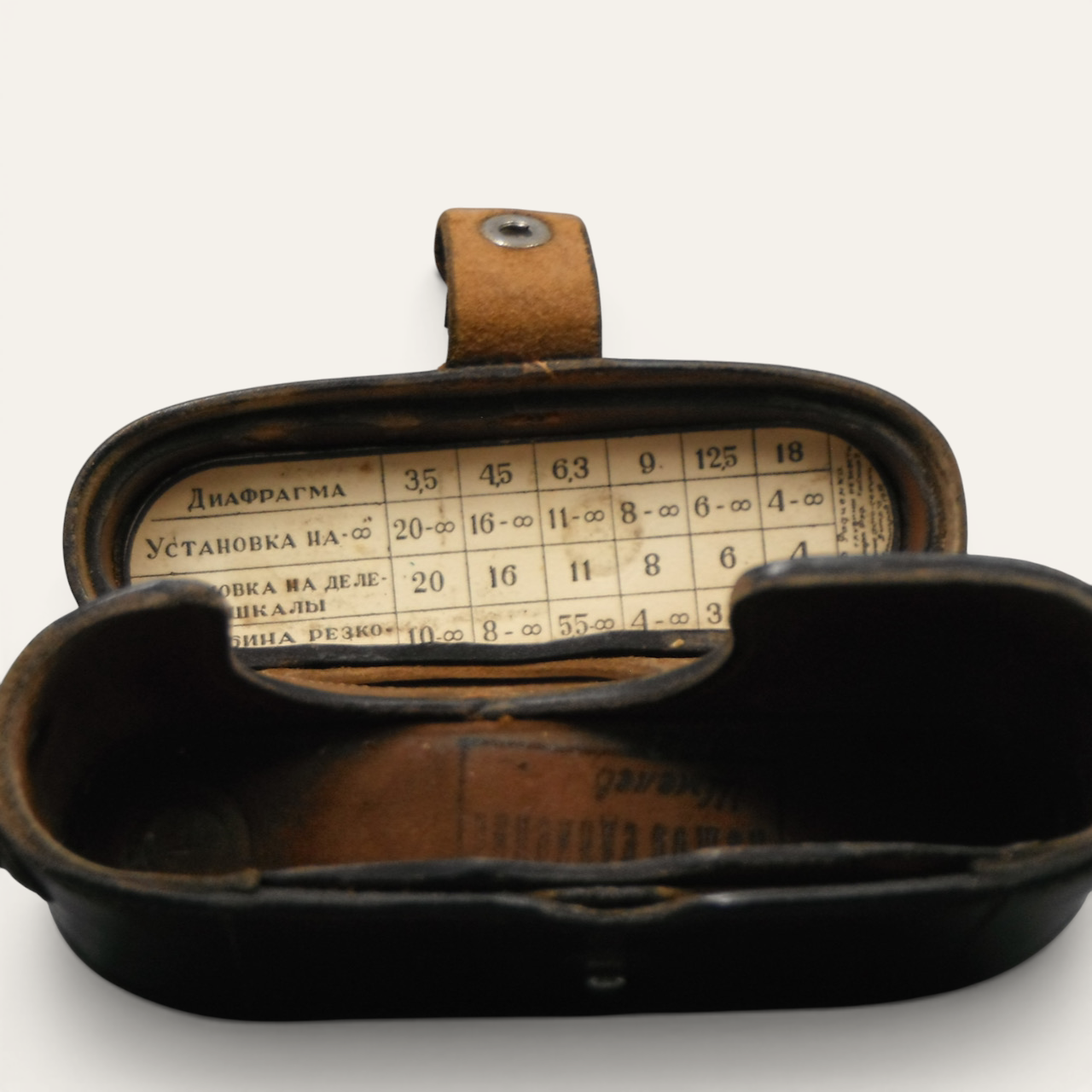
The camera here comes with the standard uncoated FED collapsible 1:3.5 f=50M/M lens, which is a copy of the Leica Elmar and has the same apertures—3.5, 4.5, 6.3, 9, 12.5, and 18 (spaced at one-stop intervals)—and a one-half-turn focus-scale in meters. The diaphragm has ten blades. The lens is thus probably contemporary with the camera.
Included
Original FED take-up spool (often missing from these cameras) Original FED genuine leather ever-ready case and neck strap. Inside the case is an ink stamp and a depth-of-focus table (both in Russian).
Operating Condition:
The camera is tested and fully operational. The viewfinder is clear and the rangefinder spot is bright; the rangefinder has been adjusted and is now spot-on. The uncoated lens is surprisingly clear and unmarked, and the diaphragm is free of oil and works smoothly. The lens collapses and focuses smoothly, but the infinity lock is weak.
Cosmetic Condition: The knurled collar around the shutter-release is missing (it is removed to mount a cable-release and is often lost). The original vulcanite is intact and the camera body and lens show some signs of use: the lens mount on the camera and on the lens show brassing, and the front ring of the lens is entirely brassed. The bottom plate of the camera has light scuffing and the trace of a tripod mount. The case is in very good condition, with a few scuffs, and wear only on the snap-flap and hinge; the strap is intact, although its metal fittings are lightly rusted.
Shop Notes
Early FED cameras occupy an important place in photographic history and remain one of the most accessible ways to own a pre-war Leica-inspired rangefinder. The inclusion of the original take-up spool, leather case, strap, and matching collapsible lens makes this an especially attractive example for collectors and photographers interested in early Soviet camera design.
To prevent damage to the shutter mechanism, always cock the shutter before changing shutter speeds.